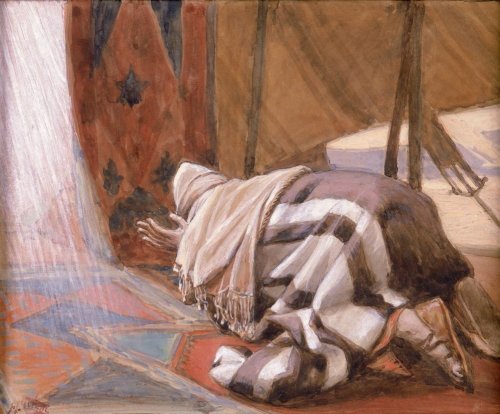
Phillip Medhurst presents 030/788 James Tissot Bible c 1899 God’s Promises to Abram Genesis 13:16 Jewish Museum New York. By (James) Jacques-Joseph Tissot, French, 1836-1902. Gouache on board.
Phillip Medhurst presents 030/788 James Tissot Bible c 1899 God’s Promises to Abram Genesis 13:16 Jewish Museum New York. By (James) Jacques-Joseph Tissot, French, 1836-1902. Gouache on board.

By (James) Jacques-Joseph Tissot, French, 1836-1902. Gouache on board.
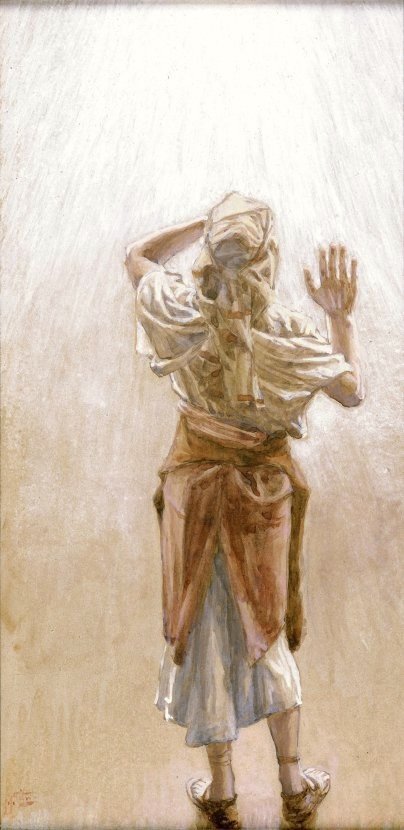
Phillip Medhurst presents 016/788 James Tissot Bible c 1899 Noah is told to build an ark Genesis 6:14 Jewish Museum New York
The scroll of the six days of creation is open for all to see in the Book of Genesis. The basis for God’s salvage-operation is also available for all to see in the Law. The scroll of the six “days” of destruction is open in the Apocalypse of John. During the seventh “day” of a thousand years God will “rest” from the destruction and Satan will be bound so that the “everlasting gospel” can be seen, unobscured by the forces of evil (Revelation 14:6-7, Romans 1:19-22). In the final consummation the scroll of creation – upon which God’s Word has been written – will be rolled up, and all will begin anew. The Light of Gnosis, God’s first creation, will once again illumine nature, and those passing the final test will be given access to the Tree of Life.
FINIS
During Jesus’ millennial rule on earth, a “great crowd” of survivors of Armageddon and of the resurrected who were unable during their natural lifespan to access the proclaimed Gospel will be able to choose the “everlasting gospel” of obedience to God in circumstances where Satan is bound and Paradise restored on earth. The 144,000 co-regents will intercede as priests for their resurrected ancestors. The Danites, however, are excluded from the spiritual Israel (Judges 17:1-18:31). Their sin against the Holy Spirit was to use religion as a justification for evil. They will be resurrected at the end of the millennium, judged, then consigned to everlasting torment in the lake of fire – a diabolical immortality.
As in the case of Abraham, faith – in a promise of immortality as yet visibly unfulfilled – is superior to obedience to the Law. While access to the Commandments was through the procreative line of Israel, faith involved a renunciation of all rights proceeding from membership of that procreative line – as in Abraham’s willingness to sacrifice Isaac and his faith in an implied promise of resurrection. The New Israel of the 144,000 sealed in Revelation are described symbolically as virgins undefiled by women. That is, they have renounced salvation by means of the procreative line. It is these who will reign with Christ on earth for 1000 years – that is, for a time equivalent to the post-lapsarian life-span of Adam, thereby putting right his flawed dominion.
The Spiritual Israel of Gnosis is symbolised in Revelation by the 12 stars crowning creation’s progenitrix Sophia (Revelation 12:1) – the faithful remnant of the “old” covenant – and by her child who, withdrawn from the world of carnality, is the ever-growing great crowd of adherents to the “new” covenant. The child’s sustenance is Scripture truly understood. The two witnesses – the Old Testament and New Testaments – were suppressed by a corrupt religion during the Constantinian apostasy (Revelation 11). No human institution can be an infallible depository of Truth; all religions are corrupted by carnal considerations. The Gnostic must turn to the lampstand of true light and the olive tree of its sustenance wherever it is to be found.
The new Exodus began in fact with Jesus’ triumphal entry into Jerusalem. Thus the “great crowd” carrying their palms (Revelation 7:9) are compared implicitly to the throng who acknowledged Jesus as the Messiah and hailed him as he embarked on the series of events which will saw him crucified by the false religion of Babylon (Revelation: 7:4-10, 14:1). The New Jerusalem is founded on both the “old” and the “new” covenants (Revelation 21:12-14): Gnostics of all ages of history are able to recognise that higher Truth and imperative which inevitably leads to martyrdom at the hand of those religious Powers-that-Be which, though unmasked by the knowledge of Truth inherent in the Gnostic, have a Protean ability to form new images of themselves to worship (Revelation 13:13).
The remnant saved by the “old” covenant is symbolised in Revelation by the 144,000 sealed; those saved by the “new” covenant in Jesus (who offers himself as a new Passover lamb and by so doing reveals his understanding of God’s plan, and is therefore alone worthy to open the seals hiding the scroll of history) is represented by the “great crowd” (Revelation 7:9). Both are symbolised by the 24 elders seen in the initial tableau beyond the door opened onto Heaven for John at the beginning of Revelation. The “old” covenants are brought about by physical movement from an old geographical place to a new one: to Ararat, Haran, Sinai, Gilgal and Jerusalem. The ”new” covenant is effected by Jesus’ physical passing into Heaven at his Ascension.

 Phillip Medhurst