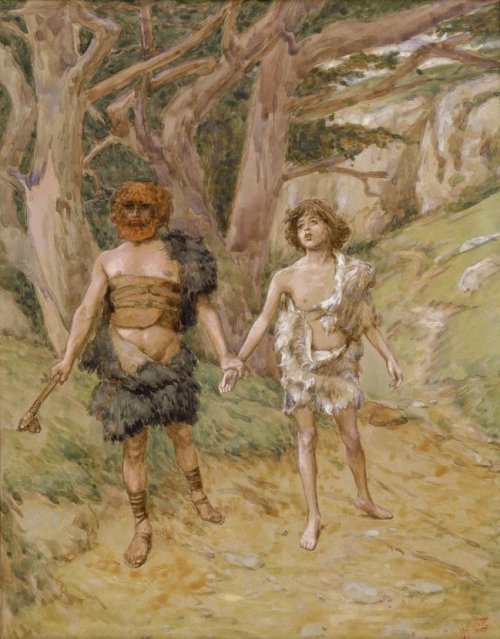
Phillip Medhurst presents 011/788 James Tissot Bible c 1899 Cain Leads Abel to Death Genesis 4:8 Gouache 23.9 × 18.7 cm Jewish Museum New York
Phillip Medhurst presents 011/788 James Tissot Bible c 1899 Cain Leads Abel to Death Genesis 4:8 Gouache 23.9 × 18.7 cm Jewish Museum New York
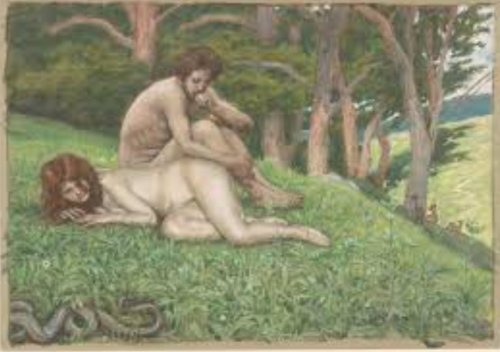
Phillip Medhurst presents 009/788 James Tissot Bible c 1899 Adam and Eve perceive their nakedness Genesis 3:7 Morgan Museum New York
One incarnation of the underground stream of Truth is the Apocalypse of John of Patmos. Unsurprisingly, visions here of the end-time are reflections of dreams of the beginnings. In both, the number seven is key as the time-sequence of the primal story, and light is the symbol by which all other symbols are seen. And yet, as if to emphasise the fact that Truth is not located in sequential order and rational lucidity, the Apocalypse constantly subverts sequence and reason in its presentation of material: the orderly and light-filled procession of the story of creation has become a nightmarish jumble, a reflection of the creation-story seen in a glass darkly – as darkened by sin and as rendered a counterfeit of God’s intended order.
I leave these frail and perishable leaves;
To rot just where they fall. The seed I’ve sown
And you take to the mould, perhaps may rise;
Although what fruit to bear I cannot say.
And as for me, who made this papyrus
To lay my aching head on bed of reeds,
Will I – in crumbling cradle quietly
Asleep, my pains all parked and epitaphed
Outside that trench dug deep to shield my shell
Against all shocks – will I unready then
Grow tongue to shape a curse on that grim Day
When an archangel’s voice might bellow down
Into my inert den? Will I be born
Again, the life-force thawing my cold blood,
Its swell conveying me to God knows where?
For, “He who dies acquitted is of sin”,
The apostle says; but at this threatened doom,
My breath must state my case, accountable.
That case is this: I hope my wanton flesh
Did not degrade the hopes I here expressed . . . . . .
I hope my leaves heal you before they die,
As though from Tree of Life, and in our mould
Which harbours many seeds, I hope what is
Sown here will one day sprout to bear bright fruits
As beautiful as gems; and if the “will”
Of what will be’s replaced by “should”, then let
Unmade, thus made again, be all made good.
If here you find the truth of what we are
Well-charactered, then of your charity
As well as for yourself, now pray for me.

This is a photo of De Loutherbourg’s original drawing pasted into the Bowyer Bible, a grangerized version of the Macklin Bible.
Bowyer Bible 43.6063/6064. Tail-piece to the first epistle of Paul the apostle to the Corinthians, vignette with sword slicing through a skull with snake in mouth. See 1 Corinthians 15:26. The print: letterpress in two columns above and on verso. 1800. Inscriptions: Lettered below image with production detail: “P J de Loutherbourg RA inv et del”, “J. Heath direx” and publication line: “Published by T Macklin June 17 1800”. Print made by James Heath. Dimensions: Height: 487 millimetres; width: 390 millimetres.
From a collection of photographs of the Bowyer Bible in Bolton Museum, England curated by Phillip Medhurst.
Phillip Medhurst
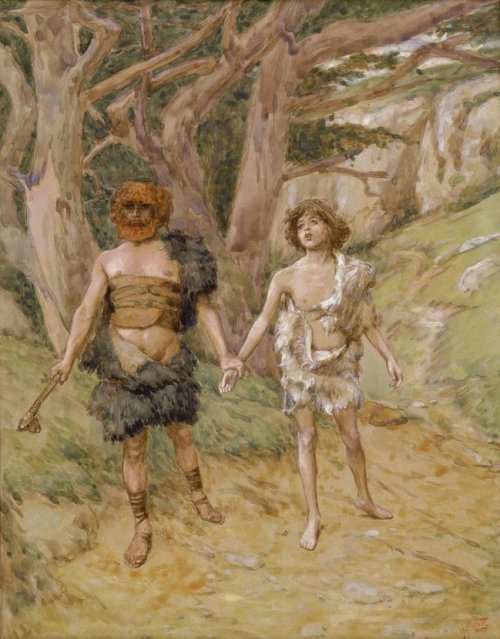

 Phillip Medhurst