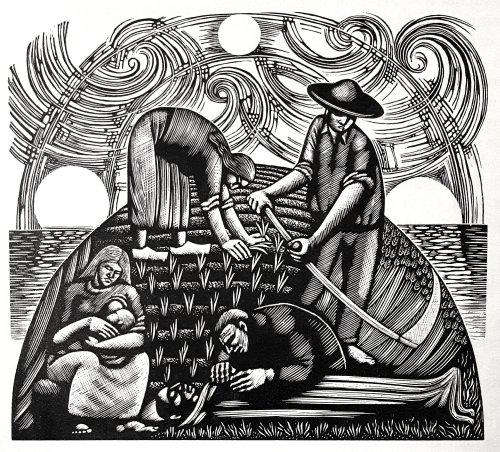
Wood engraving by Harry Brockway (British b. 1958) in The Reader’s Digest Bible (illustrated edition) 1990
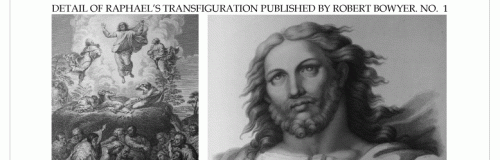
Wood engraving by Harry Brockway (British b. 1958) in The Reader’s Digest Bible (illustrated edition) 1990
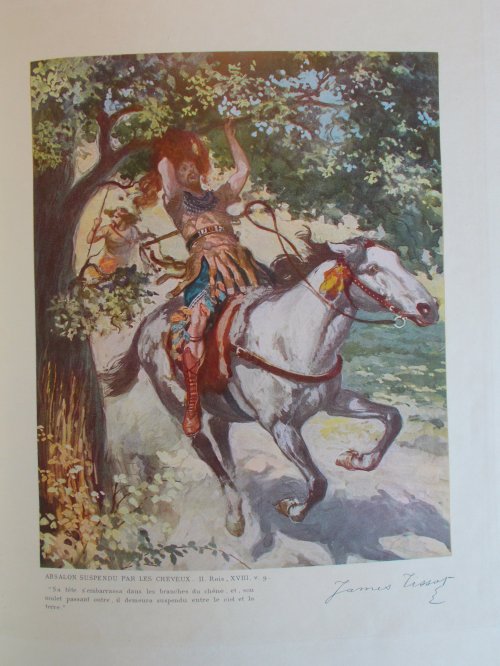
294.1/402-absalom-hanging-on-the-oak-tree-2-samuel-18:15-drawing-by-james-tissot-at-the-john-rylands-library-file-created-by-phillip-medhurst:

294.2/402-absalom-hanging-on-the-oak-tree-2-samuel-18:15-gouache-on-board-by-louis-de-parys-after-james-tissot-jewish-museum-new-york-presented-by-phillip-medhurst:

The paintings were reproduced in “La Sainte Bible : Ancien Testament . . . / Compositions par J.-James Tissot” with preface by A. D. Sertillanges, introduction by M. de Brunoff and the French version of L. J. Lemaistre de Saci. (Sertillanges, Antonin Gilbert 1863-1948; Le Maistre de Sacy, Isaac-Louis, 1613-1684) 2 vols.: illus., plates: 4to. 40 plates, 360 illustrations to text, by James Tissot (Tissot, Jacques-Joseph, French, 1836-1902). Paris: M. de Brunoff & Cie, 1904.
The edition contains 360 mounted colour, b/w, and duo-tone illustrations in the text and 40 plates in three states, sepia-tone, partly hand-coloured, and finished coloured state. The plates are protected with captioned tissue-guards. The paper size is 15 3/4 x 13 ins; image size varies (c 8 1/2 x 5 1/2 ins).
Illustration was completed after Tissot’s death in 1902 by Henri Bellery-Desfontaines, Auguste François Gorguet, Charles Hoffbauer, Louis van Parys, Michel Simonidy and Georges Bertin Scott.
Of the 561 copies printed, the John Rylands Library (Manchester) copy is an “exemplaire unique”. As well as the triple set of the large plates in various states, and a series of proofs before letters of the illustrations appearing in the text, it contains a water colour drawing by Tissot (“Joseph presents his father Jacob to Pharaoh”), his original pen and ink sketches for this work, and an autograph letter by him.
Files created by Phillip Medhurst: Tissot in Brunoff at the John Rylands
Scientists have discovered an exquisitely preserved ancient primate fossil that they believe forms a crucial “missing link” between our own evolutionary branch of life and the rest of the animal kingdom.The 47million-year-old primate – named “Ida” – has been hailed as the fossil equivalent of a “Rosetta Stone” for understanding the critical early stages of primate evolution. The Guardian 2009
In this, the Sabbath vigil of my life, I found
Myself prostrate, all helpless on the ground,
For sin had made me blind. It was as though
Throughout my life I strayed, and did not know
Where I was going or from whence I came,
Just led by some ephemeral, dancing flame
Snuffed out once it was glimpsed, and dead to sight
Before it could be fixed – the moth’s mad flight
More full of rhyme and reason than my life,
Now so replete with grief and full of strife.
I’ve looked at ev’ry explanation that
There is of life, and none come near to sat-
Isfying all criteria of truth,
Or come up with the necessary proof
That they’re the answer. All require a leap
Into absurdity – alright for sheep
Who find their comfort in conformity,
But useless for all lone-wolves such as me.
There is a way to make it work, of course,
Which is: to put on blinkers like a horse
And go just where the drayman tells you to.
But in your heart you’ll know it to be true
That, even though you’re willing to work hard,
All roads end up inside the knacker’s yard.
“Arbeit macht frei” is true to a degree,
But not the way we wish that it could be.
A product of conception, you will be
From life aborted, howe’er belatedly.
Meanwhile, you strive where chance gives no reward:
Your feeble hand upturns an empty gourd.
And so our ends are like a jelly-fish:
Sans spine, sans brain, a wat’ry upturned dish
Borne on through vastness we cannot perceive,
Still less control enough to steer. Believe
We may, but proof of purpose or a plan
Revealed consistently denied, we can
Not fabricate from our own stuff, for we
Are empty, blind, insensate, falsely free,
Borne on by tides, by winds, by currents, all
Uncomprehended, landing where we fall.
The birds seem free; no wonder, then, the dove
Is symbol of God’s Spirit from above.
But what became of all the other kinds
Of beasts not taken to the ark? – They died.
So we: into oblivion. We: free
To die and be forgotten; the elect
Disclose God’s will to naturally select.
Just like a snail I leave a glistening train
To be erased by the first fall of rain;
Or, like the scarab, roll a ball of dung,
My pyramid for when I have no tongue
To extol my own deeds. For like that bird,
(Though it may seem unlikely and absurd)
The phœnix, from the ashes (I surmise)
Once fire is spent I presently will rise
To live again; although we know within
That in this legend ashes are the “fin”.
We came. We paused. We went. We had our say.
And whether night or day, it makes no sense:
Our toil receives no lasting recompense.
The arbit’ry division of the days
As hours, minutes, seconds; and the ways
In which these segments must be spent; and how
We should be happy and fulfilled; who bow
To, who revere; and where we are consigned
To at our death: all these make chains that bind
Us. We embrace these shackles, since the free
Must for themselves define what they must be:
What “happy” is, and what should make them sad,
And wherein dwells the good, and where the bad.
Night brings no rest unless we lose ourselves
Inside a dream-world where our psyche delves
Into those wishes unfulfilled, beyond
The grasp of nightmare’s reach, a pond
Beneath whose surface deep desire thrives
Without diminishing our thwarted lives;
A magic chalice where all beauty lives,
Which takes from no-one, ever – only gives
To all, and none must beg: its grace
Wells up to all, and all can find a place.
But dawn’s cold light reveals it full of lies.
Best not to dream when we must close our eyes.
If I knew what the living of this life
Obtained, I would obtain it. All that strife,
Anxiety and hurt would contribute
To some exchequer full of meaning’s loot
Which, plundered from the stinking hold
Of death, would help me to pay off, all told,
Those bitter creditors who lay in wait
At each day’s wakening – not to this state
Of ignorance, bankrupt, without defence,
To give up hope without a recompense.
For once I rose, then fell. Again I rose
And staggered to this path. This one I chose,
To leave a trail (which will be overgrown within
Another lifetime) – not that I begin
Anew: my marks and tracks haphazard fell
Throughout this forest floor, which scarcely tell
Of feet that trod this way. For no-one cares.
Each too in isolation, lost, each fares
Towards a light too briefly glimpsed, before
A rush of wind removes what we just saw –
If not imagined. Then, sometimes, we look
To see if we can scry within the brook
From which we drink an image of the stars.
Instead, the canopy of boughs, like bars,
Blots out the sky, an ever-growing lid
Built by our past mistakes – nor can we bid
It stop. It grows and grows. The image of
The light which we remember up above
Gets dimmer as we go. And so our trail
Bequeaths no thing of value, and we fail
To teach to those who follow a true way.
 Phillip Medhurst